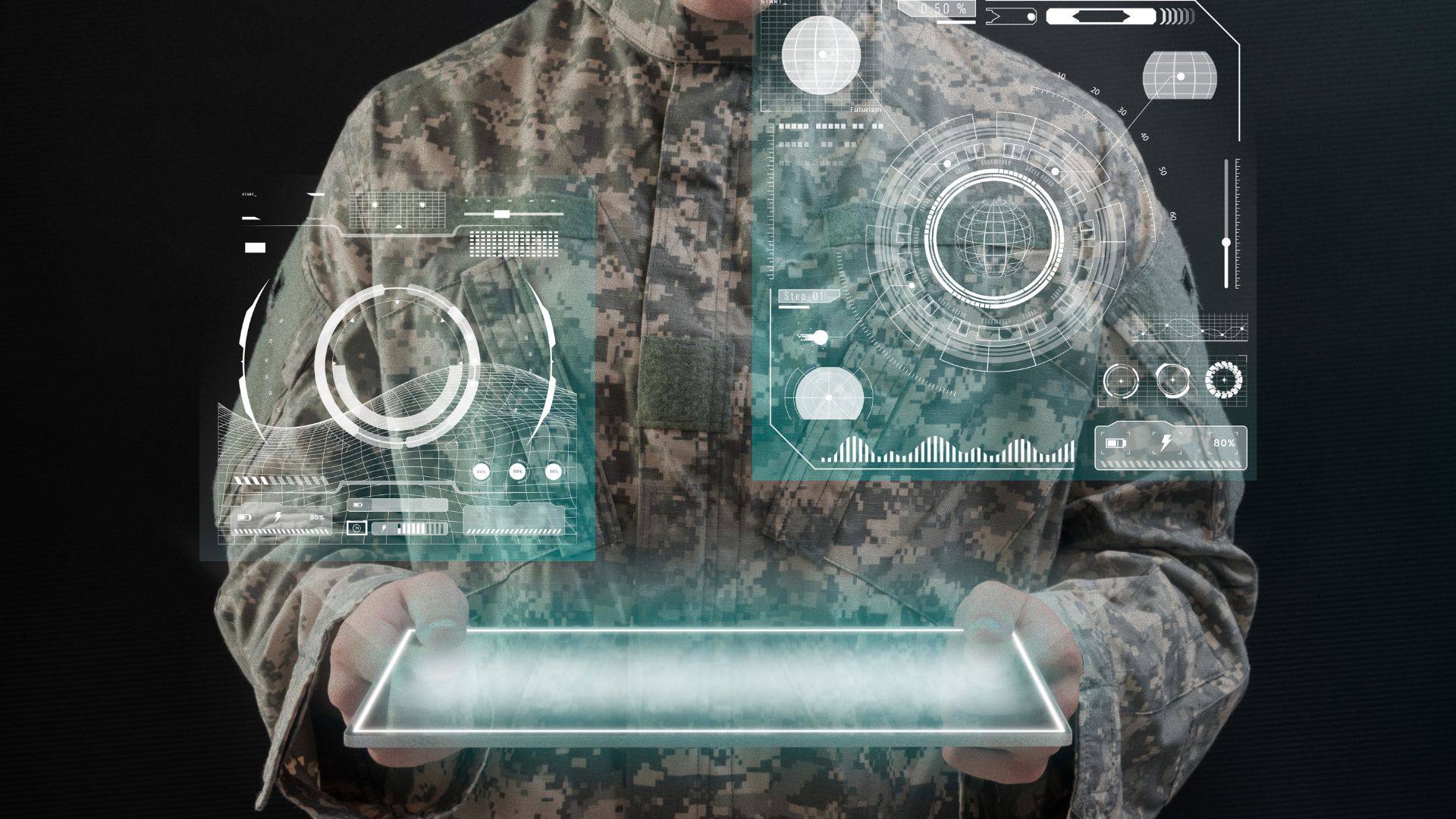
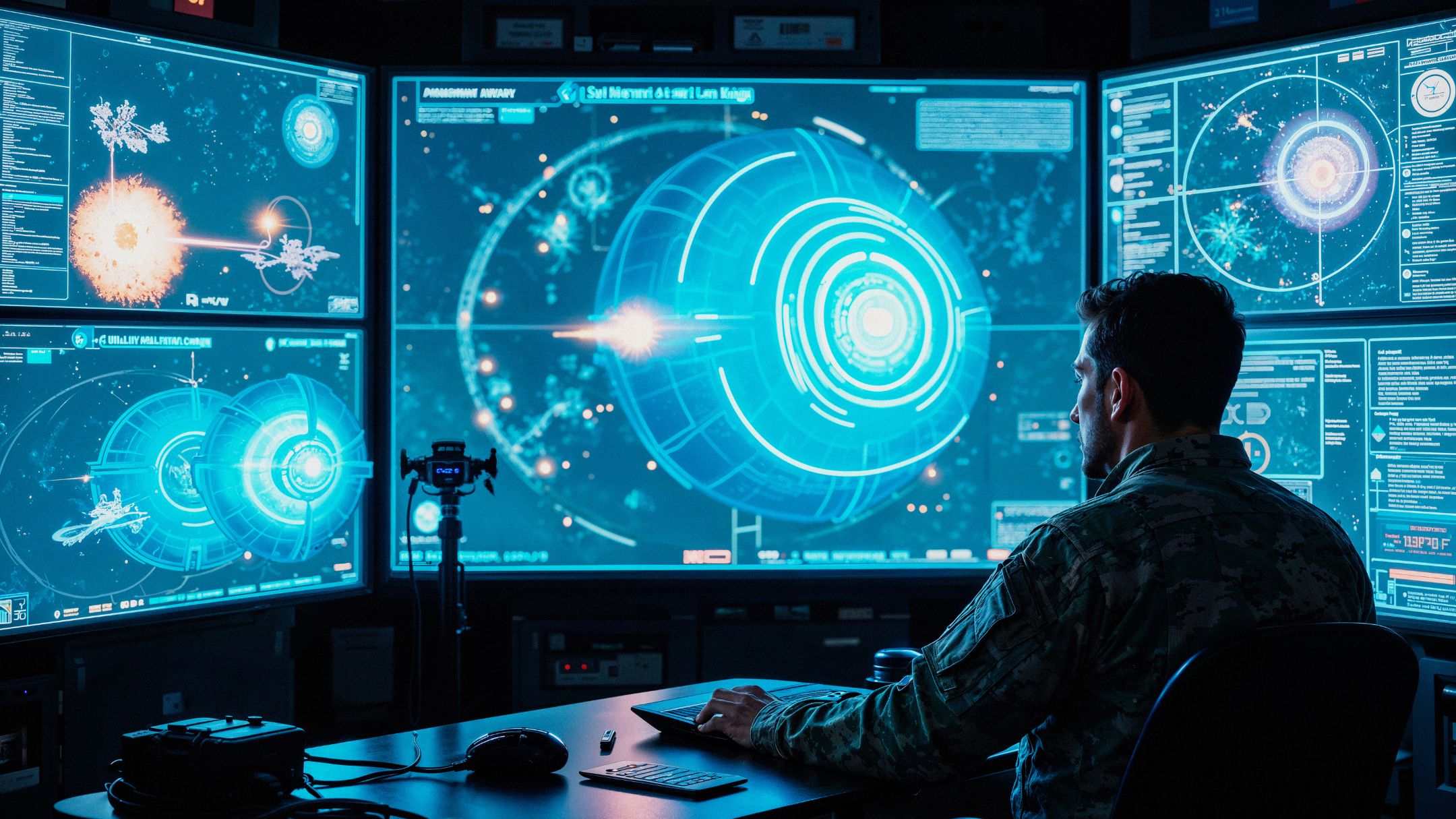
The warfare in modern times is not only characterized by physical power, the quantity of forces, and the use of conventional arms. In the 21st century, data, algorithms, and intelligent systems are as decisive as tanks and missiles. The focal point of this change is AI in Modern Warfare, an increase in technology that is remaking the way countries prepare, fight, and deter war.
Artificial intelligence has left the research laboratories and has entered actual military settings. With battlefield monitoring and drone drones, cybersecurity and war simulation, AI in Modern Warfare is reshaping speed, precision, and the decision-making process in defense operations. Activities that took hours or days to be analyzed and done by humans can now be done in seconds using AI-driven systems.
In this article on Next Gen Tech Labs, the author discusses how AI in Modern Warfare is changing military strategy, the technologies that underpin it, its implementation in reality, ethical aspects of it, and what the future might bring as artificial intelligence integrates more and more into the defense systems of the world.
What Is AI in Modern Warfare?
AI in Modern Warfare is the application of technologies based on artificial intelligence in military activities and strategic planning, i.e., machine learning, deep learning, computer vision, and autonomous systems. In contrast to software, AI systems are able to learn from data, evolve in the ever-changing environment, and predict or recommend something with little human intervention.
The contemporary battlefields provide huge amounts of information in the form of satellites, drones, radar systems, sensors, and intelligence networks. It is not possible to process this data manually. The use of AI in Modern Warfare allows military units to convert raw information into intelligence that can be used in real-time and at an unprecedented rate.
The main elements of AI in Modern Warfare are:
- Machine learning for predictive analysis
- Computer vision for target recognition
- Natural language processing for intelligence analysis
- Autonomous systems for surveillance and combat support
AI-Driven Military Decision-Making
The use of AI in decision-making is one of the most strategic effects of AI in Modern Warfare. The leaders in the military are required to make critical decisions when they are under pressure, and they are not well informed, or sometimes the information is changing too fast. The solution to this gap is through the aid of AI-based decision-support systems.
These systems help a commander to have real-time insights by analyzing information on various platforms, such as battlefield sensors, intelligence reports, satellite images, and historical trends. With AI applied to Modern Warfare, the decision-makers will be able to analyze different scenarios and predict the actions of enemy forces, in addition to minimizing uncertainty.
Military research projects, such as those directed by the Defense Advanced Research Projects Agency, are also engaged in advanced military research aimed at integrating AI to improve the command-and-control systems without eliminating human responsibility for strategic choices.
Autonomous Weapons and Intelligent Defense Systems
Some of the most visible examples of AI in Modern Warfare are autonomous and semi-autonomous systems. They consist of unmanned aerial vehicles (UAVs), remote ground units, an autonomous naval platform, and artificial intelligence-based missile defensive systems.
Artificial intelligence-driven autonomous systems are capable of:
- Navigate complex environments without GPS
- Identify and track targets using computer vision.
- Operate continuously without fatigue.
- Reduce direct human exposure to danger.
In modern warfare doctrine, AI in Modern Warfare is often implemented with human oversight, ensuring that critical decisions, particularly those involving the use of lethal force, are not left to AI.
Intelligence, Surveillance, and Reconnaissance (ISR)
Military success is based on intelligence, surveillance, and reconnaissance. Modern Warfare AI has transformed the ISR abilities in a huge way because it is capable of automating the process of analyzing huge amounts of data.
The AI algorithms will be able to work with satellite imagery, drone shots, and intercepted communications much faster than human analysts. This gives the militaries the ability to monitor troop movements, equipment buildup, and suspicious activity almost instantly.
The use of AI in Modern Warfare enables intelligence teams to acquire insights more quickly and with more accuracy, and allows them to devote more time to analysis of higher quality, instead of reviewing data by hand.
AI in Cyber Warfare and Electronic Defense
Cyber war has become another very significant sphere of conflict, and AI in Modern Warfare is essential in securing the military networks and infrastructure. The contemporary defense systems are constantly under threat of cyberattacks, spying, and digital sabotage.
Cybersecurity systems enhanced with AI have the capability to:
- Detect abnormal network behavior.
- Identify potential cyber threats before damage occurs.
- Automate defensive responses
- Strengthen resilience against electronic warfare.
Agility and rapidity are essential in cyber operations. The ability of AI in Modern Warfare to respond in milliseconds is quicker than the response of human operators.
Logistics, Supply Chains, and Predictive Maintenance
Although most attention is usually given to combat, logistics is also crucial to the success of the military. The application of AI in Modern Warfare is changing the way armies are operated in terms of supply chain management, equipment maintenance, and resource prioritization.
The AI-based logistics systems assist:
- Car and plane predictive maintenance.
- Streamlined supply shipment and inventory control.
- Resource and fuel demand prediction.
- Minimized downtime of operations.
The most significant use of AI in Modern Warfare is predictive maintenance, which enables armies to correct anomalies before the equipment malfunctions during important activities.
Training, Simulation, and War Gaming
Modern armed forces need to be trained in a way that is real, flexible, and efficient. AI in Modern Warfare improves training by means of intelligent simulation and adaptive learning environments.
Training systems based on AI are capable of simulating battlefield situations, computing the artificial behavior of the enemy, and adjusting the level of difficulty depending on the performance of the trainees. These systems enable soldiers and commanders to train on a broad spectrum of situations without live exercises at an expensive and hazardous cost.
Modern Warfare also features AI-powered war gaming that allows the strategist to test, experiment, and practice tactics before putting them into practice in real life.
Ethical and Legal Considerations
Owing to the emergence of AI in Modern Warfare, the world has been debating the ethics, accountability, and international law. In the case of autonomous weapons, especially, there is a question of accountability when it comes to making decisions by machines.
The major ethical issues are:
- Responsibility of AI activities.
- Explainability and transparency of AI systems.
- Unintended escalation risk.
- Adherence to the international humanitarian law.
Other organizations, such as the North Atlantic Treaty Organization, are in the process of producing guidelines that will make AI responsible and ethical in military interventions.
Geopolitical Implications of AI in Modern Warfare
AI in Modern Warfare is not merely a technological change but a geopolitical change as well. The military AI leaders of nations enjoy the strategic benefits of deterring, gathering information, and speed.
With the world’s superpowers pumping a lot of money into AI-controlled defense systems, artificial intelligence is emerging as the key variable in the formation of alliances, military policies, and balances of power. The AI race is changing the way future wars will be fought or even avoided.
The Future of AI in Modern Warfare
In the future, AI in Modern Warfare will probably be more integrated into all spheres of the military. Future perspectives may be:
- Multidomestic AI systems on land, sea, air, space, and digital space.
- Improved AI-human interaction.
- Clear AI to explain military decisions.
- Less emphasis on offensive and disruptive use.
The development of AI technologies will lead to an increasing number of military approaches based on flexibility, information advantage, and smart automation.
Conclusion
The concept of AI in Modern Warfare is radically altering the way modern armies act, plan, and defend. Autonomous systems and intelligent surveillance, cyber defense, predictive logistics, and artificial intelligence are transforming every level of military strategy.
The article AI in Modern Warfare is an emerging area of research focusing on next-generation technology, and the article demonstrates the potential, as well as the responsibility, that advanced innovation entails. This is critical to understanding not only the role of artificial intelligence in the future of global security but also to defense professionals, technologists, and other people interested in this area.
On websites like Next Gen Tech Labs, exploring topics such as AI in the Modern Warfare assists in illuminating the ways in which the advanced technologies are changing the world now and in the coming years.