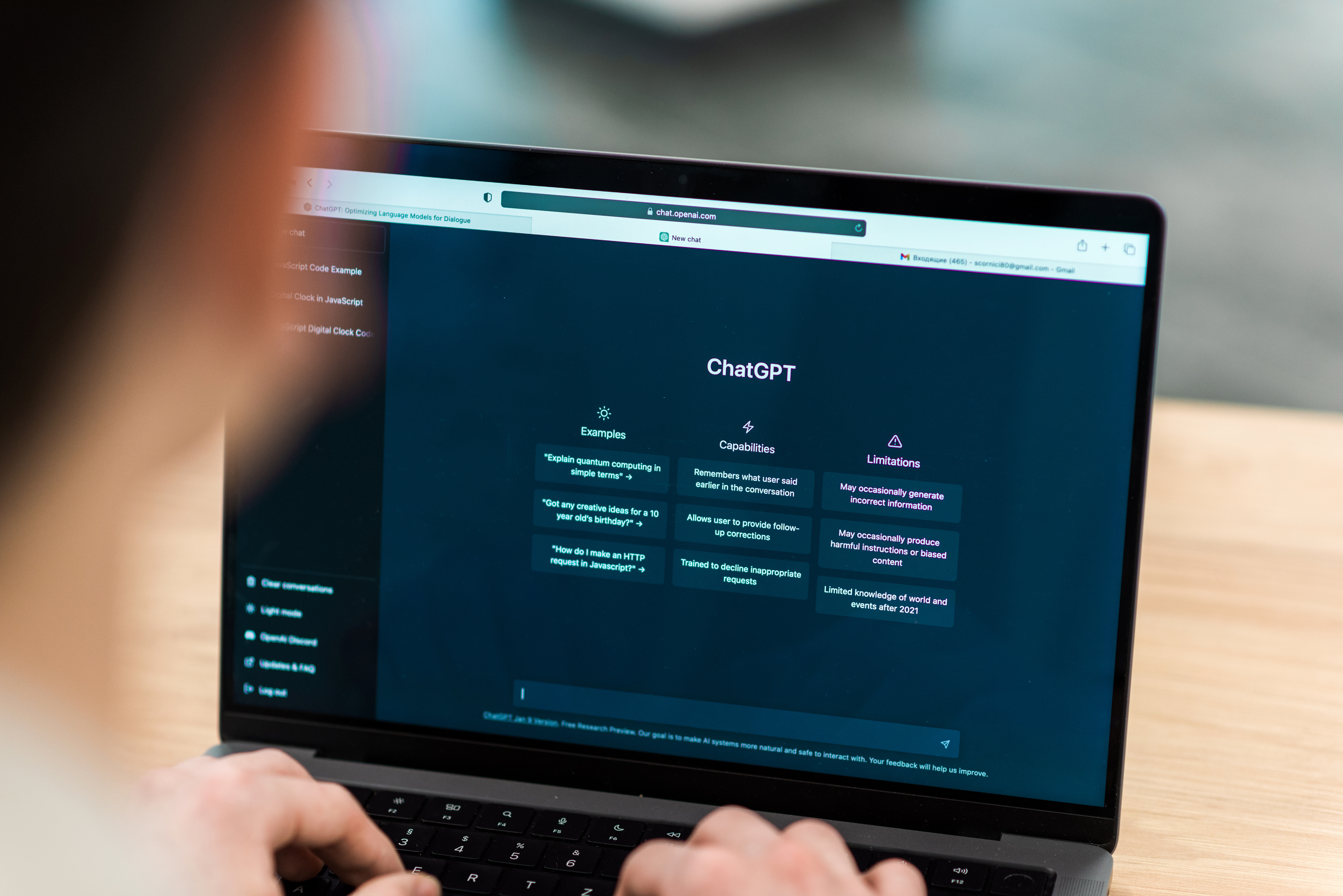
AI is no longer a research lab experiment but now a part of daily life, changing the work, learning, and interaction of people with technology. ChatGPT is a conversational AI platform and one of the most powerful things that has occurred in this field, and it has altered the way humans interact with machines using natural language. The heart of this revolution is the ChatGPT Model, a powerful language model that was created to comprehend, process, and produce human-like responses in large scale.
Since its public introduction, the ChatGPT Model has developed quickly across all areas in education, software development, marketing, healthcare, and customer service. The article by Next Gen Tech Labs is an in-depth, end-to-end exploration of the inside story of the ChatGPT Model, the details of how it found its way into the market, how it operates internally, how people apply it to real life, how it stacks up against other emerging competitors, and what the future of ChatGPT holds amidst a highly competitive landscape of AI.
The Emergence of ChatGPT in the AI Market
ChatGPT is a product of OpenAI, which is pursuing a larger goal of providing safe and practical Artificial Intelligence. Although conversational AI was not a novel concept, the ChatGPT Model has become the most notable system because of its capacity to produce contextual, coherent, and human-like responses on a wide variety of subjects.
The accessibility was what made the launch significant. The ChatGPT Model was not restricted to enterprise systems or research prototypes but was publicised by the use of a simple chat interface. This reduced the entry barrier and enabled millions of people using AI to engage with advanced AI without technical expertise.
What Is the ChatGPT Model Today?
The ChatGPT Model can now be characterized as a large-scale language model that is trained on large quantities of textual data. Its major role is to forecast and produce text depending on the context given by a user. The ChatGPT Model is not based on the use of predetermined scripts as opposed to rule-based systems. Rather, it acquires linguistic patterns, structures, and relationships during training.
The present version of the ChatGPT Model supports:
- Multi-turn conversations
- Retention of the context between the sessions.
- Reasoning-based responses
- Generation of codes and debugging.
- Summarisation and translation.
- Operational and artistic imaginings.
This development has made the ChatGPT Model a general-purpose AI system and not a specialized chatbot.
How the ChatGPT Model Works
Architecture Behind the ChatGPT Model
The ChatGPT Model is based on transformer architecture, which is a neural network architecture optimized to operate on sequential data, including text. Transformer-based models have attention mechanisms that enable the model to analyse the relationship between words in the sentence, even when they are distant.
ChatGPT Model will be able to:
- Think situationally, not through single words.
- Be resulting in longer responses.
- Self-adapt tone and style.
Training the ChatGPT Model
ChatGPT Model is trained in several stages:
1. Pre-training
The model is trained with the help of large datasets with books, articles, websites, and more publicly available text. At this phase, the ChatGPT Model acquires grammar, facts, logical patterns, and the overall language structure.
2. Fine-tuning
The ChatGPT Model is fine-tuned by the human trainers, who also give example dialogues and rank the answers. This assists the model in being closer to human expectations.
3. Reinforcement Learning
It is accomplished by feedback loops to increase accuracy, minimize harmful outputs, and maximize usefulness.
Such a multi-level strategy enables the ChatGPT Model to become increasingly better as time goes on.
How the ChatGPT Model Understands Prompts
The ChatGPT Model does not interpret language in the human meaning of the word. It, instead, gives prompts a probabilistic interpretation. When a user makes a query, the ChatGPT Model breaks it down, detects patterns, and predicts the most probable sequence of words as a response.
Key capabilities include:
- Intent recognition
- Context awareness
- Detection of semantic similarity.
- Generation of adaptive response.
These processes render the ChatGPT Model quite effective in conversations and instructions.
Real-Life Uses of the ChatGPT Model
Education and Learning
The ChatGPT Model can be used by students and educators to:
- Concept explanations
- Homework assistance
- Exam preparation
- Research summaries
The ChatGPT Model is not a substitute for education but an additional learning tool.
Software Development
The developers trust the ChatGPT Model in:
- Writing and reviewing code
- Debugging errors
- Training on new programming languages.
- Generating documentation
The ChatGPT Model is especially useful in the development process because of its capacity to comprehend the technical context.
Business and Marketing
Companies use the ChatGPT Model to:
- Content creation
- Email drafting
- Market research summaries
- Automation of customer support.
Organizations will be able to enhance efficiency and lower the costs of operations by incorporating the ChatGPT Model.
Daily Productivity
Users use the ChatGPT Model on a day-to-day basis to:
- Writing assistance
- Planning and scheduling
- Idea generation
- General problem-solving
This broad use outlines the adaptability of the ChatGPT Model in daily life.
User Adoption and Daily Usage Trends
The number of people who use the ChatGPT Model on a daily basis varies, but it is a common fact that there are millions of users daily. It is used by students, professionals, creators, researchers, and enterprises.
The factors that still make this adoption persist are:
- Ease of use
- Broad applicability
- Rapid response generation
- Constant enhancement of the ChatGPT Model.
Competition in the AI Chatbot Space
The ChatGPT Model is a successful product that has created a high level of competition. A few different AI systems compete with each other in the market.
Major Competitors
- Google Gemini – Combines with Google’s ecosystem and search capabilities.
- Perplexity AI – Specializes in answers related to citation.
- Cursor AI – Developers optimized.
- New experimental technologies such as Antigravity AI.
Nevertheless, the ChatGPT Model can still be considered a competitive element, as it has a balance between usability, flexibility, and support of an ecosystem.
Will Users Continue to Use ChatGPT?
One of the frequently posed questions is whether users will give up ChatGPT as more AI-powered tools appear on the market. Although the competition will have an impact on the user behavior, the ChatGPT Model has several advantages that include high brand recognition, frequent updates, and a large developer ecosystem.
Instead of becoming irrelevant, the ChatGPT Model will probably co-exist with specific tools as a general-purpose AI assistant, with the rest being specific to a particular niche of application.
The Future of the ChatGPT Model
In the future, it is probable that the ChatGPT Model will consist of:
- Greater logical abilities.
- Improved factual accuracy
- Improved multimodal interaction (text, image, audio).
- Stronger personalization
- Improved integration of the enterprise.
The development of the ChatGPT Model will also be influenced by ethical issues, transparency, and responsible implementation of AI.
With the increase of AI regulation and expectations, the ChatGPT Model will have to balance innovation, as well as trust and safety.
Challenges and Limitations
The ChatGPT Model has weaknesses, despite its strengths:
- It is subject to giving wrong or obsolete information.
- It does not have actual comprehension or awareness.
- Timely quality is very much needed in outputs.
- The reduction of bias is still a persistent issue.
It is important to understand that the ChatGPT Model is limited to responsible use.
Conclusion
The ChatGPT Model will be one of the significant milestones in the history of artificial intelligence that will fill the gap between intricate machine learning systems and human interaction on a daily basis. Since its launch in the market and its popularity today, the ChatGPT Model has shown the possibility of conversational AI to positively influence productivity, learning, and creativity.
Although the presence of the competition with such tools as Gemini, Perplexity, and Cursor AI will persistently determine the AI ecosystem, the ChatGPT Model can be placed at the core. Its flexibility, lifelong learning, and generality make it one of the technological factors that will be crucial in the future of human-AI cooperation.
The ChatGPT Model is not merely a tool available at Next Gen Tech Labs, but it is the basis of the next generation of intelligent systems, one that will keep on changing as the people using it do.