
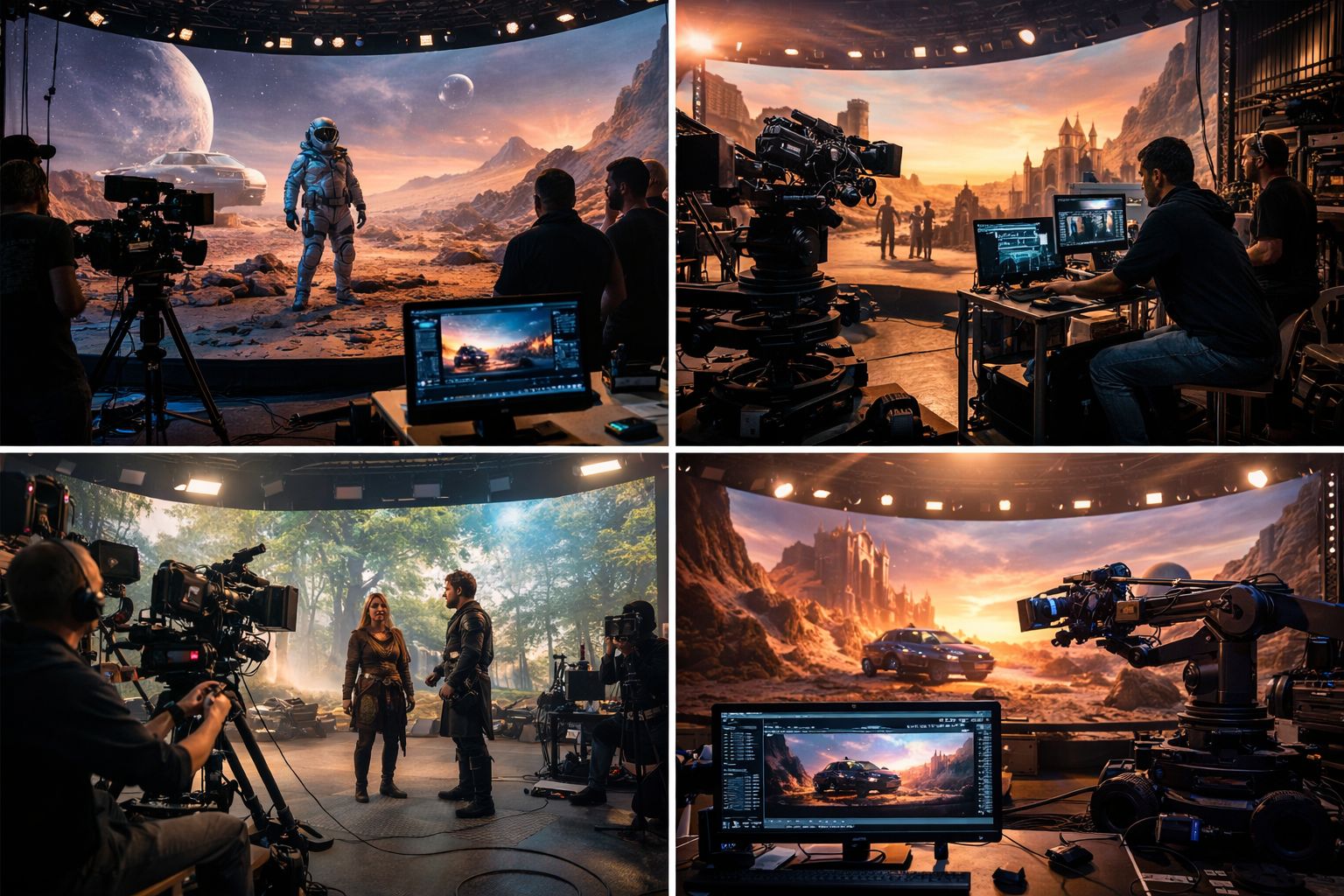
Next Gen Tech Labs equips us with the understanding of how new technologies are transforming industries, creativity, and how human beings experience innovation. Vital changes that are arising in the world of filmmaking today are among the most thrilling due to the high rate of embracing Virtual Production Technology.
The development of the motion picture had been on a constant pace with the technological advancement, the shift of the old analog cameras into digital cinema, and the effects of filming to more sophisticated CGI. Virtual Production Technology is now the next big jump that intertwines reality filmmaking with the digital real-time setting.
This Technology is not only transforming the appearance of movies, but it is also turning around the way they are planned, shot, and produced. Virtual Production Technology is eliminating the constraints of the past and enabling creators to visualize final scenes in the production process, creating new forms of creativity. This article explores the future of this innovation in filmmaking in great detail by Next Gen Tech Labs.
What Is Virtual Production Technology?
Virtual Production Technology is a new form of creating movies that combines real-time computer-generated settings with live-action shooting. Filmmakers do not need to focus on green screens and post-production visual effects as much as they can view realistic digital backgrounds on set.
Virtual Production Technology enables physical and digital content to co-exist onscreen when shooting the film using LED walls, real-time rendering engines, motion capture systems, and camera tracking tools. This streamlines the creative process and minimizes uncertainty by a great deal.
At its broadest extent, Virtual Production Technology enables the gap between imagination and execution, enabling the filmmakers to make creative choices instantly and see feedback in a visual manner.
How Virtual Production Technology Works
The mechanism of Virtual Production Technology will help to understand why it is receiving widespread usage in the entertainment industry.
Real-Time Digital Environments
Complex 3D environments are created by advanced game engines and can be rendered in real-time. These environments are dynamic for camera movement, and thus, the Virtual Production Technology is much more immersive than the traditional method.
LED Volume Stages
Green screens are substituted with large LED monitors that depict real-life settings with natural light and shadows. This is among the characteristic traits of Virtual Production Technology, which enhances visual realism to a significant degree.
Camera Tracking Systems
Precise camera tracking sees that the digital backgrounds move in tandem with the camera movement. True depth and perspective are achieved through this synchronization, and virtual scenes become real.
Collaborative Workflow
Collaboration is one of the strongest strengths of Virtual Production Technology. Cinematographers, visual artists, and directors are able to collaborate in real-time and minimize errors as well as creative delays.
Why Virtual Production Technology Is Changing Filmmaking
Greater Creative Control
Moviemakers are allowed to experiment with Virtual Production Technology. Lights, surroundings, and camera angle can be changed on the spot, and this is an incentive to explore the creative side without extra expense.
Reduced Production Costs
Virtual Production Technology aids in cutting costs by reducing location shoots and fixes during post-production, allowing high-quality visualization.
Faster Production Timelines
Conventional filmmaking tends to divide production and post-production. Virtual Production Technology is a combination of these steps, which dramatically saves time.
Improved Performances
Actors do not perform well when they are not capable of perceiving real environments and responding to them. This is another human factor that makes Virtual Production Technology change the modern way of filmmaking.
Virtual Production Technology vs Traditional Green Screen
Green screens had been the industry standard for visual-effects-heavy scenes for several years. They were effective, but in most cases, required a lot of post-production.
Virtual Production Technology advances on this by:
- Providing real-time visual feedback.
- Giving proper lighting and reflections.
- Minimizing post-production hassles.
- Improving innovative decision-making.
These are the benefits that explain why Virtual Production Technology is quickly overtaking the green screen workflow.
Expanding Beyond Films
Although the most obvious application of Virtual Production Technology is in the field of cinema, it is also making an impact on several other areas of creation.
Television and Streaming Platforms
Virtual Production Technology is the preferred choice in long-term storytelling due to the reusability of virtual sets.
Advertising and Digital Media
Virtual Production Technology allows brands and creators to create visually rich commercials without the need to travel physically.
Gaming and Cinematic Storytelling
Game developers use Virtual Production Technology to generate film trailers and narrative-based experiences.
Education and Simulation
Virtual Production Technology is also being implemented in training programs and learning content to drive an immersive learning experience.
The Role of AI in Virtual Production Technology
Virtual Production Technology is evolving at a faster rate due to artificial intelligence. Tools based on AI are used to assist in the creation of the environment, optimization of lighting, camera planners, and rendering.
Virtual Production Technology will become more accessible as AI continues to develop, and allow smaller creators the opportunity to explore the highest production methods.
Challenges and Limitations
Although Virtual Production Technology has advantages, it also has its challenges:
- High initial investment
- Technical complexity
- Hardware requirements
Nevertheless, due to the development of technology and its increased use, these obstacles are gradually lowering, and Virtual Production Technology is becoming more mainstream.
The Future of Filmmaking
The future of filmmaking is real-time, immersive, and digitally enhanced. The Virtual Production Technology is likely to become a common tool in the entertainment world.
Upcoming trends include:
- Fully virtual film sets
- Hybrid physical-digital productions.
- Rapid international cooperation.
- Increased accessibility for independent filmmakers.
Designed to provide essential changes in the creation of stories, as Next Gen Tech Labs emphasizes, Virtual Production Technology is not merely an upgrade but a radical change in the creation of stories.
Conclusion
In Next Gen Tech Labs, we follow the innovations of the future, and Virtual Production Technology is one of the changes that will revolutionize the filmmaking industry today. It transforms creative processes and opens new narrative horizons by combining real-time digital space with live actions, thus redefining creative dynamics in order to create a new form of narration.
With the entertainment industry on an ever-changing road, Virtual Production Technology will have a major influence on the production of films and other visual images. This technology is a preview of the future for people who want to know what might appear in the future regarding technologically-driven creativity.