
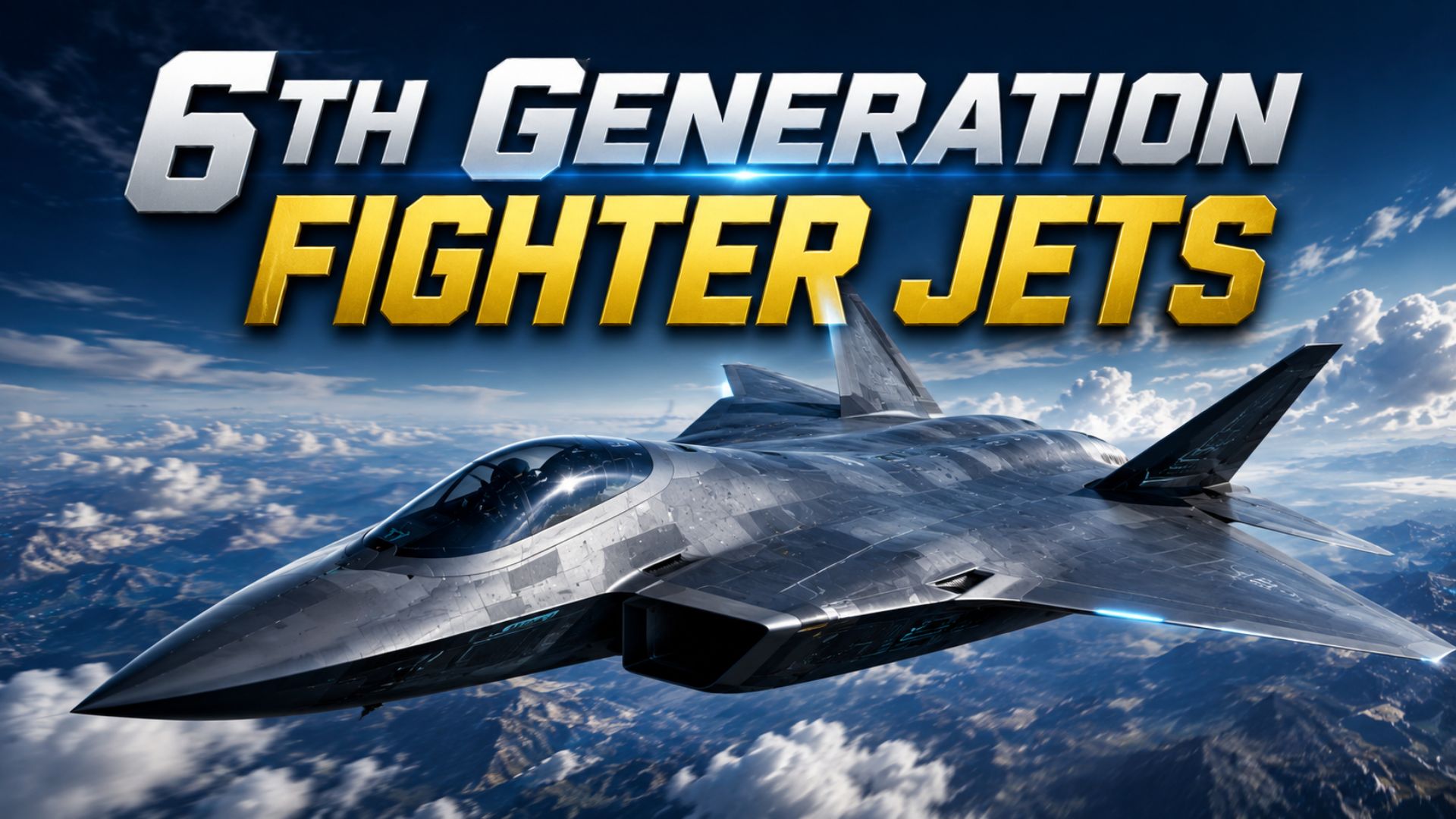
Today, the future of military aviation is moving forward so fast that 6th Generation Fighter Jets will be the most advanced combat aircraft ever created. Countries all over the world are pouring billions of dollars into R&D to create aircraft that are able to outsmart, outstealth, outautonomize and outnetwork opponents on future battlefields using AI, AI-powered systems, advanced stealth and next-generation networking technologies.
These planes will not be “fifth generation” fighters, but instead will serve as an intelligent command center that can be launched from the air and used to send real-time messages and data to drones, satellites, naval vessels and ground forces. Modern fighter jets in 6th Generation technologies are not just faster, they are a revolution in warfare.
NextGenTechLabs is very aware of new innovations in the aerospace industry that influence the future of defense technology. With ever-changing military tactics, 6th Generation Fighter Jets are now a vital part of the world’s defense programs and the aerospace industry.
This detailed NextGenTechLabs guide delves into the technologies, capabilities, benefits, challenges and future implications of these groundbreaking aircraft.
What are 6th Generation Fighter Jets?
The 6th Generation Fighter Jets are the next generation of fighter aircraft. These are advanced fighters that will be built to compete with fifth-generation aircraft like the F-35 Lightning II and F-22 Raptor, and will be equipped with artificial intelligence, better connectivity, autonomy, and the latest in weapons technology.
The overarching goal of the 6th Generation Fighter Jets is to offer unprecedented situational awareness and battlefield dominance in both air and other domains such as land, sea, space and cyberspace.
Analysts estimate that such planes will start flying into service in the 2030s and will be around for decades.
Evolution of fighter aircraft.
To understand the importance of 6th Generation Fighter Jets, it is necessary to look back at the evolution of fighter aircraft.
First Generation Fighters
- Early jet-powered aircraft
- Basic combat capabilities
- Limited avionics
Second Generation Fighters
- Supersonic flight
- Improved radar systems
- Guided missile integration
Third Generation Fighters
- Better maneuverability
- Enhanced mission flexibility
- Advanced weapons systems
Fourth Generation Fighters
- Fly-by-wire controls
- Multi-role combat capabilities
- Greater operational efficiency
Fifth Generation Fighters
- Stealth technology
- Sensor fusion
- Network-centric warfare
Sixth Generation Fighters
- Artificial intelligence integration
- Autonomous drone coordination
- Directed energy weapons
- Enhanced stealth systems
- Multi-domain connectivity
This evolution is an example of the future of military planes because of 6th generation fighter jets.
Key Technologies Behind 6th Generation Fighter Jets
Artificial Intelligence Integration
One of the most important characteristics of the 6th Generation Fighter Jets will be Artificial Intelligence. AI systems will process vast quantities of battlefield data as it happens, assisting pilots to make quicker and more informed decisions.
AI offers several advantages, such as:
- Rapid threat identification
- Mission optimization
- Automated data analysis
- Reduced pilot workload
- Predictive maintenance capabilities
These smart systems will have a significant impact on effective operation in complex combat scenarios.
Advanced Stealth Technology
In the future, Stealth is crucial to air superiority missions. But 6th Generation Fighter Jets will probably be more than just stealthy.
Expected advancements include:
- Adaptive camouflage technologies
- Reduced infrared signatures
- Advanced radar-absorbing materials
- Electronic stealth systems
The innovations will provide improved survivability and mission success in hostile environments.
Manned-Unmanned Teaming
Manned-unmanned teaming is perhaps one of the most game-changing technologies in the future of combat aviation. In 6th Generation Fighter Jets, pilots can control more than one autonomous drone, referred to as loyal wingmen.
These drones can assist missions in the following ways:
- Conducting surveillance
- Gathering intelligence
- Carrying weapons
- Acting as decoys
- Carrying out electronic warfare operations
This ability increases the effectiveness of combat and decreases pilot risk.
Directed Energy Weapons
Laser systems and other directed energy technology may be used on future military aircraft. Engineers hope to use these systems in 6th Generation Fighter Jets for offensive and defensive missions.
Potential applications include:
- Destroying incoming missiles
- Neutralizing hostile drones
- Disrupting enemy sensors
To assist in electronic warfare operations.
Future air combat strategies may be totally altered by directed energy weapons.
Advanced Sensor Fusion
In the modern era, information superiority is a key strength of the modern warfare. 6th Generation Fighter Jets will utilize sensor fusion technology to help them integrate data from various sources into a unified and comprehensive battlefield picture.
The following data sources can be used:
- Satellites
- Ground radar systems
- Naval assets
- Airborne warning platforms
- Autonomous drones
Better situational awareness and better tactical decision making.
Future Fighter Aircraft Expected Capabilities
Extended Operational Range
In the future, there may be conflicts that call for aircraft to fly over long distances. More fuel efficiency and mission endurance will occur due to advanced propulsion systems.
Advantages include:
- Longer combat missions
- Less reliance on aerial refueling
- Greater strategic flexibility
Superior Battlefield Awareness
Pilots will be able to process and react to information quicker than ever before thanks to advanced computing systems.
Expected benefits include:
- Real-time threat assessment
- Enhanced mission coordination
- Faster tactical responses
- Improved combat effectiveness
These will be a great asset in modern warfare.
Cyber Warfare Integration
Cyber security and cyber warfare capabilities will be an important feature of future aviation platforms as military operations increasingly become digital.
Future systems may:
- Defend critical networks
- Disrupt enemy communications
- Support electronic attacks
- Strengthen information warfare efforts.
Resilience in the cyber domain will be a critical need for next generation combat aircraft.
The global programs developing 6th Generation Fighter Jets.
United States – Next Generation Air Dominance (NGAD)
The NGAD program is a development of the United States Air Force, one of the most ambitious aerospace programs in the world. This project is about developing 6th Generation Fighter Jets that can be used to sustain air superiority against future threats.
Program priorities include:
- Long-range performance
- Artificial intelligence integration
- Advanced stealth capabilities
- Autonomous support systems
Global Combat Air Programme (GCAP)
Global Combat Air Programme is a partnership between the United Kingdom, Italy and Japan to build next generation combat aircraft.
Key objectives include:
- AI-enhanced operations
- Advanced sensor networks
- Future-ready weapons integration
- Superior connectivity capabilities
This is a significant step towards the 6th Generation Fighter Jets, according to many defense analysts.
China’s Advanced Fighter Development
China is still spending a ton of money on the modernization of its military and on future aerospace technologies. Experts think its next generation of aircrafts will incorporate several technologies that have been used on 6th Generation Fighter Jets, such as artificial intelligence and advanced stealth features.
The competition growing all around the world is driving innovation in the defense industry.
Advantages of 6th Generation Fighter Jets
Introducing 6th Generation Fighter Jets brings in a number of strategic benefits for contemporary armed forces.
Enhanced Survivability
Advanced stealth technology makes it hard to detect and engage.
Improved Situational Awareness
AI systems offer all-round battlefield intelligence.
Greater Operational Flexibility
Drones can be integrated to enhance the mission capabilities.
Faster Decision-Making
Automated Data Processing enhances response time in combat.
Multi-Domain Warfare Capability
Future aircraft will be able to operate flexibly between the various military domains.
We think NextGenTechLabs will transform the way air combat and defense will be used in the future.
The future combat aircraft and its challenges
Although these cutting-edge platforms have immense potential, there are challenges to their development.
High Development Costs
The research, testing, manufacturing and deployment are expensive.
Technological Complexity
The incorporation of AI, robotics, autonomous systems, advanced weaponry, and stealth technologies requires innovative engineering solutions.
Cybersecurity Risks
For military aircraft, the protection of critical systems from cyber threats is becoming more important as the aircraft becomes more connected.
Training Requirements
Future pilots need to be able to operate on the battlefield with advanced technologies, manage autonomous assets and digital battlefield systems.
NextGenTechLabs experts point out that to achieve successful deployment, it will be crucial to overcome these challenges.
The Future of Air Warfare
The advent of 6th Generation Fighter Jets is a big change in military tactics. Warfare of the future will be more and more dependent on intelligent systems, inter-connectivity and man-machine co-operation.
6th Generation Fighter Jets will not be used as individual airplanes; instead, they will be part of a larger combat system involving a combination of satellite, drone, naval, and ground systems.
NextGenTechLabs emphasized that these aircraft are likely to play a key role in future defense strategies and national security frameworks.
Conclusion
The evolution of 6th Generation Fighter Jets is one of the most crucial developments in military aviation history. With AI, next-gen weapons systems, advanced stealth, and autonomous drone operations, these birds will establish a new standard for air superiority for decades to come.
The investments in these technologies worldwide are significant because in today’s complex security environment, military readiness must be ensured. With the ongoing advancements in technology, 6th Generation Fighter Jets are expected to become an integral part of the future of aerial warfare and defense operations.
At NextGenTechLabs, we’re staying up to date with the latest advancements in the aerospace and defense sector. The development of 6th Generation Fighter Jets is not just a technological achievement, it’s a peek into the future of intelligent, connected and highly capable military aviation.