In today’s rapidly changing warfare, AI, robotics, cyber, and directed energy systems are advancing at a rapid pace. Military Laser Weapons Technology is among the most groundbreaking technologies that has impacted the world of modern warfare. Laser weapons, once thought to be science fiction, are now emerging as actual weapons of war in air defense, naval security, and anti-drone wars.
Because modern battlefields demand a response to threats that is quicker and more accurate, governments around the world have invested billions of dollars in the development of more sophisticated defense systems. Military Laser Weapons Technology has been rapidly growing in the global military landscape due to the proliferation of drones, hypersonic missiles, and electronic warfare.
At NextGenTechLabs, we are monitoring closely the technologies that are shaping the future of warfare. The experts agree that the Technology of Military Laser Weapons is soon to play a vital role in military modernization due to the incomparable precision, speed, and operational efficiency that it offers.
Laser systems are different from conventional weapons, which use bullets or explosives, in that they can disable or destroy targets instantly through the use of concentrated energy beams. The rising relevance of Military Laser Weapons Technology reflects the changing nature of defence solutions on the battlefield, which need to be faster and smarter.
This blog from NextGenTechLabs will explain the working, applications, pros, cons, and future of laser warfare.
What is Military Laser Weapons Technology?
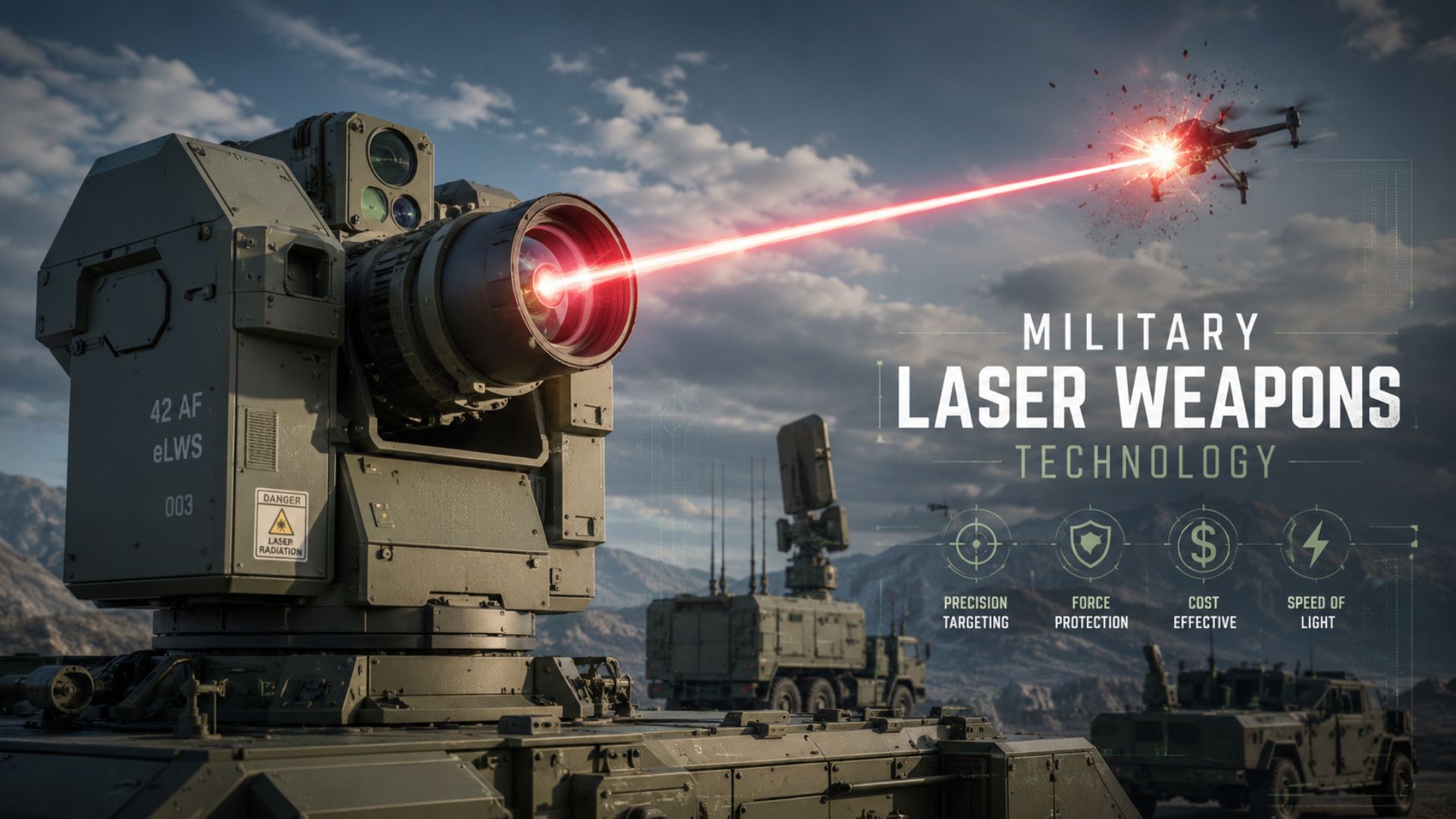
Military Laser Weapons Technology is the use of highly concentrated beams of electromagnetic energy to damage or destroy an enemy target. Unlike conventional ammunition, they emit a high-intensity heat that can fry electronics, burn through material, or block incoming threats.
LASER is an acronym for “Light Amplification by Stimulated Emission of Radiation.” Military forces are now working on laser systems for the interception of drones, missiles, rockets, aircraft, and surveillance systems.
The greatest benefit of Military Laser Weapons Technology is its ability to exploit speed. Laser beams propagate at the speed of light, enabling them to hit their target within virtually no time.
NextGenTechLabs experts are convinced that the battlefields of tomorrow will heavily depend on the accuracy and reduced expense of laser defense.
How Directed Energy Weapons Work
To understand Military Laser Weapons Technology, a few significant points must be considered.
Power Generation
The effectiveness of laser weapons depends on huge power consumption. Generators, batteries, and capacitors are used in advanced military systems to generate sufficient energy to produce high-intensity laser beams.
If the power generation system is efficient, the laser defence system will generate more powerful and accurate laser beams, so it is important to consider the power generation system.
Beam Creation
Once the energy is created, photons are further amplified by stimulated emission. These photons become synchronized and form a powerful beam of energy.
In a directed energy system, beam quality is one of the most critical elements as it affects targeting accuracy.
Target Tracking
Today, radar, infrared sensors, AI-based targeting software, mirrors, and state-of-the-art optics are used to direct beams accurately in modern laser systems.
Military laser weapons technology provides accuracy that enables military operators to destroy fast-moving aerial threats.
Target Destruction
The laser beam, upon impacting the target, produces heat very quickly on its surface. This heat can burn electronics, start fires, compromise structures, or power down enemy systems.
Laser-based defense systems have a high success rate in the fight against drones and missiles, due to their speed and accuracy.
Types of Laser Weapon Systems
Various types of laser systems are under development for military uses.
High-Energy Laser Systems
Such systems are used to neutralize drones, missiles, and rockets. In many countries, systems using high-energy lasers are considered key components in future air defense systems.
Fiber Laser Systems
Energy is amplified in fiber lasers using optical fibers. These systems are compact, efficient, and reliable.
The maintenance and scalability of fiber-based laser systems is increasingly a requirement of modern-day defense organizations.
Solid-State Laser Systems
Solid-state lasers are lasers that involve solid materials as gain media. These systems are more energy efficient and maintenance-friendly.
The majority of next-generation laser weapon projects are based on solid-state laser weapons.
Applications of Military Laser Weapons Technology
As directed energy technology advances, Military Laser Weapons Technology has been growing in capabilities and range of application in military operations.
Counter-Drone Defense
Of all the uses, one of the largest ones is drone defense. Drones are being used more and more for surveillance and attacks.
The use of Military Laser Weapons Technology in modern air defense is of great value, as the laser can quickly neutralize drones.
Missile Interception
The laser systems can detect incoming rockets and missiles and prevent them from reaching the ground. Response time is very rapid, as laser beams travel at the speed of light.
This is a significant development in the field of missile defense.
Naval Warfare
Ships are being retrofitted with laser weapons for the defense against hostile drones, boats, and missiles.
Advanced Military Laser Weapons Technology has already been successfully tested aboard naval vessels by the United States Navy.
Aircraft Protection
Laser defense systems that are able to destroy incoming threats are to be introduced into military aircraft very soon.
An airborne laser system that could enhance the survivability of an aircraft in flight.
Border Security
Governments are also looking at laser systems for border security and protection of infrastructure.
At NextGenTechLabs, the experts believe that laser weaponry defenses will be increasingly seen in the field of national security operations.
Advantages of Military Laser Weapons Technology
Several important advantages are responsible for the rapid development of Military Laser Weapons Technology.
Speed of Light Engagement
Response time to targets on the battlefield is quicker, since a laser beam collides with a target in virtually no time.
This is highly effective against rapid threats in Military Laser Weapons Technology.
Precision Targeting
Small targets can be targeted with high precision using laser systems.
The accuracy of Military Laser Weapons Technology minimises collateral damage.
Lower Operational Costs
The traditional missile systems have a high cost, and the laser systems need mainly electrical energy.
This also makes laser weapon systems cheaper to use in the long run of military operations.
Reduced Ammunition Dependency
Laser weapons do not heavily depend upon mechanical ammunition.
This is a logistical benefit, which enhances the efficiency of directed energy systems.
Challenges and Limitations
Although significant progress has been made, there are still a number of technical challenges to Military Laser Weapons technology.
Weather Interference
A laser beam can be distorted, and accuracy is compromised by rain, fog, smoke, and dust.
One of the largest challenges for Military Laser Weapons Technology is environmental conditions.
High Energy Requirements
The electrical power needed for laser systems is huge.
There are still energy efficiency concerns with portable laser weapon platforms.
Cooling Systems
Laser weapons emit a lot of heat while firing.
To ensure the proper operation of Military Laser Weapons Technology, advanced cooling systems are required.
Countries Leading Laser Weapon Development
Many countries are making a huge investment in laser-based military systems.
United States
The U.S. is still a leader in Military Laser Weapons Technology. Firms such as Lockheed Martin and Raytheon are still working on cutting-edge defense equipment.
China
China is quickly advancing research on directed energy systems.
It is noted that the development of Chinese Military Laser Weapons Technology is a sign of the greater competition in modern warfare.
Israel
Israel has built sophisticated laser air defense capabilities that can intercept rockets and drones.
Israeli Military Laser Weapons Technology is assuming greater significance in national security.
Global investment in laser defense systems will remain high and continue to rise rapidly, NextGenTechLabs experts believe.
The Future of Military Laser Weapons Technology
Artificial Intelligence, Automation, and Directed Energy systems will be crucial to the future battlefield. Experts say Military Laser Weapons Technology will be one of the most significant developments of the 21st century in the world of military.
There may be further developments to come:
- The AI-enabled laser targeting systems.
- Portable laser rifles
- Autonomous anti-drone systems
- Space-based defense platforms
- Laser interceptor for missiles
Combining AI and Military Laser Weapons Technology has the potential to transform how the military operates and how efficiency and automation are applied on the battlefield.
At NextGenTechLabs, the researchers are hoping to create future systems of lasers that will be smaller, faster, and more energy-efficient.
Conclusion
Directed energy systems continue to rapidly evolve, changing the landscape of modern warfare. Military Laser Weapons Technology is transforming the way the military operates, from defending against drones and intercepting missiles to protecting naval vessels and aircraft.
Laser weapons are much faster, more accurate, and more efficient than traditional weapons. Despite the weather sensitivity and power demands, system performance is continually being enhanced through innovations.
Directed energy systems are what we see as the next big advancement in military innovation at NextGenTechLabs. In the future, Military Laser Weapons Technology will be increasingly vital to defense operations as AI and energy storage technologies advance.
The autonomous laser systems that can instantly neutralize threats are expected to play a key role in battlefields of the future, according to the military experts. Military Laser Weapons Technology has the potential to be one of the most important defense technologies of this century, being used both on the ground and on the water, in the air, and even in space.