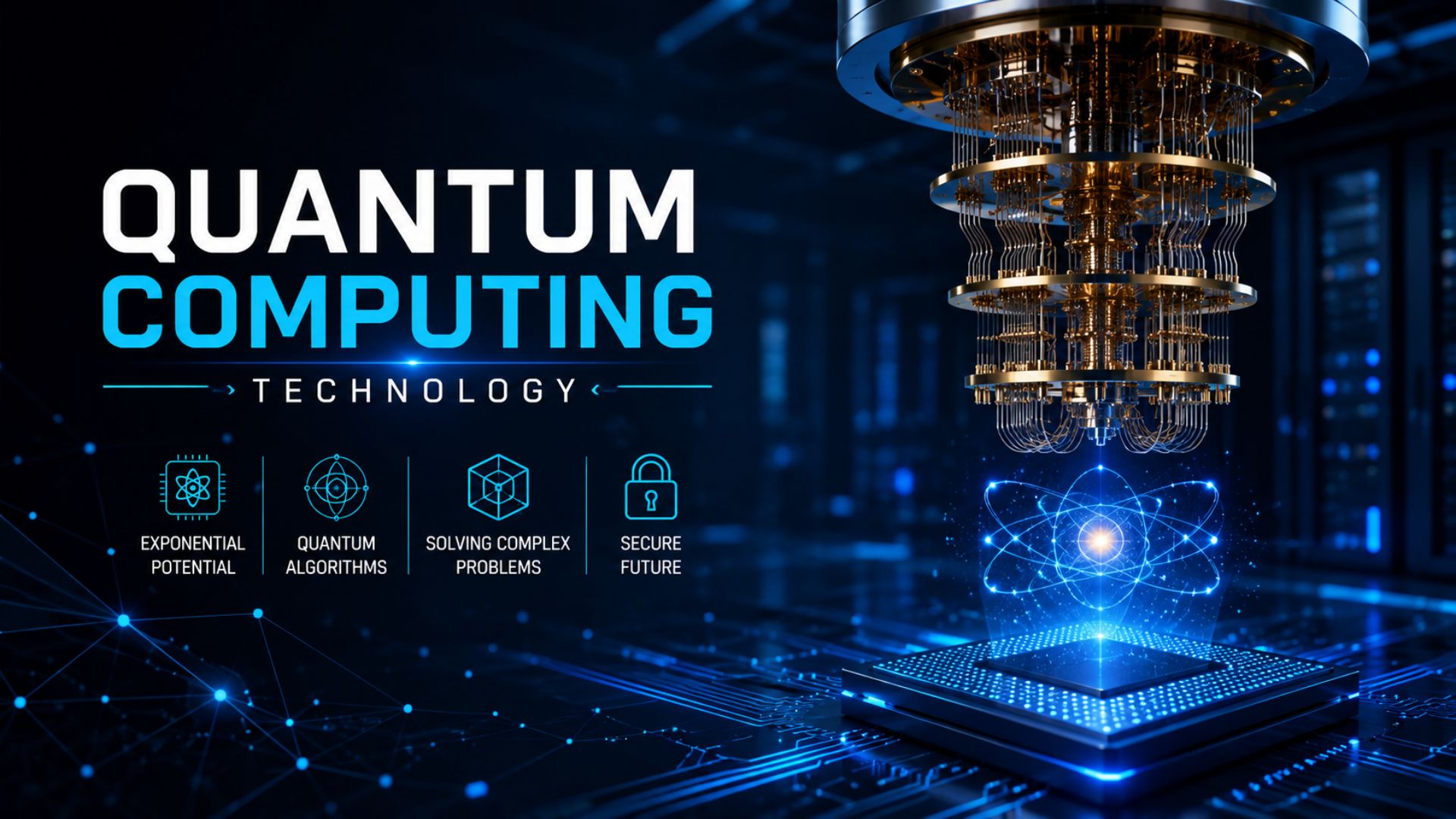
The world is moving into a new phase of innovations with Quantum Computing Technology. In contrast to the binary logic employed by traditional computers, a quantum computer employs the principles of quantum mechanics to solve extremely complicated problems at unparalleled speeds. This is a major scientific and technological achievement, which scientists and technology companies think may be one of the biggest in recent history.
The industries in recent years have invested so much in quantum research with their eye on the potential of revolutionizing medicine, AI technology, cybersecurity, and climate sciences. The scientists hope that with Quantum Computing Technology, they will make discoveries that are impossible to make through conventional supercomputers.
NextGenTechLabs monitors the latest emerging technologies and scientific innovations, which can help readers better understand the impact these new technologies will have on the future. With their groundbreaking capabilities, quantum systems are increasingly gaining traction in the science and tech world.
While governments and international entities are continuing to grow their quantum research initiatives, experts say that this decade may bring revolutionary advances in science discovery and computing.
What is Quantum Computing Technology?
Quantum Computing Technology is a state-of-the-art computing technology solution, developed using quantum mechanics, which is a branch of physics that deals with particles at the atomic and subatomic level.
Typical computers encode bits as either 0 or 1. The principle of superposition is used in quantum computers, where the state of the qubits can be in more than one state at a time. This enables quantum systems to evaluate vast amounts of information much more efficiently.
Entanglement is another key concept of Quantum Computing Technology. Rather, the entangled qubits continue to be linked, enabling information to be processed in ways not possible for classical computers.
These principles allow quantum systems to be used in solving scientific and mathematical problems that require vast computational power.
How Quantum Computers Work
By understanding the workings of quantum systems, the scientists are convinced that this innovation is revolutionary.
Qubits and Superposition
Qubits can have more than one possibility stored at the same time as binary bits.
For example:
∣ψ⟩=α∣0⟩+β∣1⟩
This quantum state is a way of illustrating qubits being in multiple states at once.
Quantum Entanglement
Entanglement allows qubits to be held together no matter how far apart they are physically located. This one-of-a-kind property gives a dramatic boost to computational efficiency.
Quantum Interference
With the help of Quantum interference, incorrect computational results are filtered out and accurate results are reinforced, which allows Quantum Computing Technology to be used efficiently in optimization and simulation.
The Evolution of Quantum Computing Technology
Quantum Computing Technology could be thought of for the first time in the 1980s when scientists were able to notice that classical computers were unable to accurately simulate quantum systems.
Physicist Richard Feynman theorized that quantum computers, based on quantum principles, could outperform traditional computers. Since then, massive progress has been made in the fields of engineering, computer science and physics, driving forward research in quantum computing around the world.
Nowadays, key technology firms, research labs, and governments are racing to create scalable quantum processors. Industry experts highlighted in NextGenTechLabs say quantum innovation is emerging as one of the most significant science fields in the future.
Why Quantum Computing Matters
The significance of Quantum Computing Technology is that it can resolve very complex computations much quicker than conventional computers.
Advanced Scientific Simulations
Molecules, atoms, and chemical interactions can be simulated with high precision in quantum systems. This is something that has the potential of revolutionizing the scientific process and speeding up innovation.
Faster Problem Solving
Quantum algorithms can be used to solve optimization problems with larger data sets more efficiently.
Improved Artificial Intelligence
AI systems are data hungry and demand a lot of processing. Machine learning models and predictive systems can be enhanced using quantum computing.
Applications of Quantum Computing Technology
Quantum systems have many possible applications in the future in various industries.
Healthcare and Drug Discovery
One of the most promising uses of Quantum Computing Technology is in healthcare. The behavior of molecules can be studied using quantum simulations and pharmaceutical research can be accelerated.
Today, drug discovery takes years, but with quantum calculations, it would take much less time.
Climate and Environmental Research
Climate prediction models use a tremendous amount of environmental data. The quantum systems could enhance the ability to predict climate patterns and predict the weather more accurately.
Researchers also anticipate that quantum systems will be able to help with strategies to optimize renewable energy and reduce carbon emissions.
Financial Services
Fraud detection, Investment analysis, and risk management are areas of interest for banks and financial institutions in the field of Quantum Computing Technology.
Quantum algorithms could be more efficient than traditional algorithms in processing large amounts of financial data.
Cybersecurity
A significant debate about Quantum Computing Technology is encryption and digital security.
Even if a quantum system could crack existing forms of encryption one day, scientists are already working on quantum-resistant forms of cybersecurity to safeguard future digital infrastructure.
Space Exploration
Researchers think quantum systems can help with more sophisticated simulations for future space exploration missions and spacecraft design.
Quantum Computing and Artificial Intelligence
In the future, AI is likely to be closely integrated with quantum systems.
Machine learning models are able to process a vast amount of information, and quantum computing could revolutionize the speed and accuracy of analysis. This mix may enhance the capabilities of image recognition systems, predictive analytics, and language processing tools, among other applications, experts say.
Platforms like NextGenTechLabs remain dedicated to advancing the field of AI and quantum technology to explore the potential future applications of these innovations in various industries.
Challenges Facing Quantum Computing Technology
Although this technology has huge potential, there are several barriers to its generalisation.
Qubit Instability
Qubits are extremely fragile and easily affected by temperature changes, electromagnetic noise, etc.
Error Correction
Computing errors are more likely to occur in quantum systems compared to classical computers. Advanced correction methods are being developed for increased reliability.
High Development Costs
Expensive infrastructure and specialized environments are needed for building stable quantum hardware.
Limited Commercial Availability
Most of the quantum systems still exist in the experimental stage and practical applications at scale are still in development.
Industries Investing in Quantum Innovation
There are several industries that have been investing heavily in quantum research to be able to get a competitive edge in the long run.
Technology Companies
Leading tech companies around the world are creating quantum computers and platforms based on the cloud.
Pharmaceutical Industry
Quantum simulations are being applied in the healthcare industry to enhance medical research and drug development.
Automotive Sector
Automotive companies are exploring how quantum technology can be used in battery technology and driverless vehicles.
Government and Defense
The governments appreciate the strategic significance of Quantum Computing Technology in the fields of science and national security.
The Future of Quantum Computing Technology
Quantum innovation is looking very bright for the future. A quantum system is expected to address scientific problems that will not be solvable by conventional computers in the future.
The applications that may be developed in the future have the potential to change the face of medicine, renewable energy, cybersecurity, and cutting-edge scientific studies. Leading companies that invest in developing quantum technology will be able to leverage significant technological benefits in the near future.
The Science and Tech sections of NextGenTechLabs detailed some of the next wave of innovations which will define the future of digital transformation on a global scale, including quantum computing.
Conclusion
Quantum Computing Technology is ushering in a new era in science. Quantum systems can use quantum-mechanical principles to solve complex problems in a manner that is faster and more efficient than it would be using traditional computers.
Quantum innovation’s potential to revolutionize industries is immense, ranging from healthcare and artificial intelligence to cybersecurity and environmental sciences. Despite the problems of qubit instability and its high cost of development, the world is investing in quantum research in a rapid way.
In an era of constant technological evolution, websites such as NextGenTechLabs enable readers to be informed about the new technologies that are developing in the future.
Quantum computing is no longer a theoretical science, it is one of the most powerful technologies of the future.